Who's Watching?
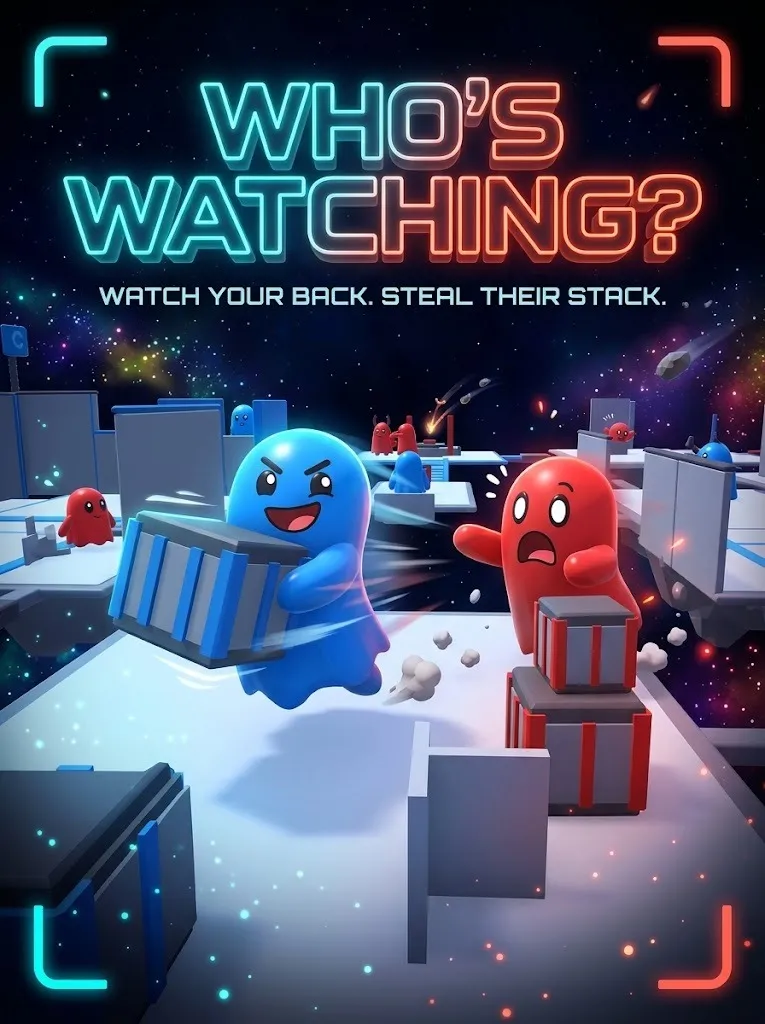
A team arena game where looking at someone is how you help or hurt them.
Results
1st
Place at NED GameCon
60
Automated tests passing
24
Host/client checks in the network smoke test
Context
NED GameCon is a game development competition at NED University. Teams get 48 hours to go from an idea to a playable build.
Problem
Most arena games are about who shoots first. We wanted attention itself to be the weapon. Two teams race through objectives, and where you look decides who gets faster and who gets slower. It had to work over LAN for 2v2 matches, built in 48 hours.
Constraints
- 48 hours from start to judging.
- Four people, most of us new to Unity multiplayer.
What I built
We co-developed a 3D arena game where your gaze is a mechanic. Looking at a teammate supports them; looking at an opponent disrupts them.
- Checkpoint placement and sabotage as team objectives.
- Procedural character animation instead of hand-keyed clips.
- Networked combat over LAN with Unity Netcode for GameObjects. The host owns movement, gaze checks, objectives and match results, so clients cannot disagree about who won.
My part: the characters and their procedural animation, plus the game’s UI and HUD.
What I’d do differently
Our automated tests ran two copies of the game on one machine. Real LAN play on separate PCs only got checked by hand, near the end. Next time I’d get two laptops talking to each other in the first few hours, because that’s where the real network bugs show up.
I’d also plan sound from day one. The audio system was ready, with a slot for every sound, but we ran out of time to drop the clips in.
Four moments from the real source Repo ↗
// Scripts/Player/CharacterPresentation.cs
void LateUpdate()
{
    if (!player || !player.IsSpawned) return;
    // Exponential smoothing is frame-rate independent and eases both starts and stops.
    float blend = 1 - Mathf.Exp(-8 * Time.deltaTime);
    speed = Mathf.Lerp(speed, TeamLobby.GameplayAllowed ? player.AnimationSpeed.Value : 0, blend);
    bool dancing = Animator && (Animator.GetCurrentAnimatorStateInfo(0).IsName("Buff") ||
        (Animator.IsInTransition(0) && Animator.GetNextAnimatorStateInfo(0).IsName("Buff")));
    expression = Mathf.Lerp(expression, dancing ? 0 : 1, blend);
    bool airborne = player.Airborne.Value;
    if (wasAirborne && !airborne) landing = 1;
    wasAirborne = airborne;
    airBlend = Mathf.Lerp(airBlend,airborne ? 1 : 0,blend);
    landing = Mathf.Max(0,landing-Time.deltaTime*4);
    phase = Mathf.Repeat(phase + Time.deltaTime * Mathf.Lerp(Floating ? 0.65f : 0.8f, Floating ? 1.05f : 1.8f, Mathf.Clamp01(speed / 5)) * Mathf.PI * 2, Mathf.PI * 2);
    SampleMotion(phase,speed,expression*(1-airBlend));
    ApplyJumpShape(airBlend,landing);
    ApplyActions();
}

// ...same file
public void SampleMotion(float cycle, float metersPerSecond, float weight = 1)
{
    CapturePose();
    float moving = Mathf.SmoothStep(0,1,Mathf.Clamp01(metersPerSecond/5));
    float amount = MotionAmount * weight;
    float bob = Floating ? Mathf.Sin(cycle) * Mathf.Lerp(0.012f,0.045f,moving) : (1-Mathf.Cos(cycle*2))*0.018f*moving;
    float sway = Mathf.Sin(cycle) * (Floating ? 0.025f : 0.014f) * moving;
    float roll = Mathf.Sin(cycle) * (Floating ? 4.5f : 3.5f) * moving;
    float pitch = (Mathf.Sin(cycle*2)*1.5f + (Floating ? 3 : 4))*moving;
    transform.localPosition = restPosition + new Vector3(sway,bob,0)*amount;
    transform.localRotation = Quaternion.Euler(pitch*amount,0,roll*amount)*restRotation;
    // Imported Devil axes are rotated; stretch along upright, not FBX local Y.
    Vector3 up = Quaternion.Inverse(restRotation)*Vector3.up;
    up = new Vector3(Mathf.Abs(up.x),Mathf.Abs(up.y),Mathf.Abs(up.z));
    float stretch = Mathf.Sin(cycle*2) * (Floating ? 0.012f : 0.025f) * moving * amount;
    transform.localScale = Vector3.Scale(restScale, Vector3.one*(1-stretch*0.5f)+up*(stretch*1.5f));
}

// Tests/EditMode/AppearanceTests.cs
[Test] public void GhostArmsMatchBodyAndDevilAccentsAreLighter()
{
    var ghost=AssetDatabase.LoadAssetAtPath<GameObject>(Root+"Prefabs/Character/Ghost.prefab").GetComponent<TeamTint>();
    Assert.That(ghost.Slots.Length,Is.GreaterThanOrEqualTo(3));
    Assert.That(ghost.Slots.All(s=>s.Strength==1),Is.True,"Ghost arms and body must use the identical main color");
    var devil=AssetDatabase.LoadAssetAtPath<GameObject>(Root+"Prefabs/Character/Devil.prefab").GetComponent<TeamTint>();
    Assert.That(devil.Slots.Any(s=>s.Strength==1),Is.True);
    var accents=devil.Slots.Where(s=>s.Strength<1).ToArray();
    Assert.That(accents.Length,Is.GreaterThanOrEqualTo(4));
    for(byte i=0;i<TeamPalette.Count;i++)
    foreach(var slot in accents)
Assert.That(Color.Lerp(slot.BaseColor,TeamPalette.Color(i),slot.Strength).grayscale,Is.GreaterThan(TeamPalette.Color(i).grayscale));The entry point
LateUpdate runs after Unity's Animator, so my procedural motion sits on top of the clips. It only reads networked state (speed, airborne), so every player sees the same pose.
The tricky part
A plain lerp(x, target, 0.1) eases faster on a 144Hz screen than on 60Hz. 1 − e^(−8·dt) gives the same ease at any frame rate, for starts and stops alike.
The fix
The Devil model came in from the FBX with rotated axes, so squash-and-stretch on local Y bent it sideways. The fix finds 'up' in the model's own space and stretches along that.
The test
An edit-mode test checks every team colour on both characters: the Ghost's arms match its body, and the Devil's accents always come out lighter than the base.